

The Mississauga News printed an opinion article by MCAC member, Andrew Hamilton-Smith on July 21, 2009. The printed article was an edited version. Mississauga Cycling is pleased to post the full original article prepared by Mr. Hamilton Smith:
As the city puts the finishing touches on its Cycling Master Plan, cyclists are holding their collective breath in anticipation. Through public consultations held over the past year, the citizens of Mississauga have consistently identified one cycling priority above all others: connectivity. Basically, people want to be able to ride their bike to and from various destinations, in a way that is both safe and easy to navigate.
Various cities around the world are taking tremendous strides in accommodating cyclists, and have reaped substantial benefits for doing so. Riding a bicycle instead of driving a car reduces traffic congestion, emits no pollution, and it is in the health interests of the riders themselves.

Montreal appears to not only provide a well-connected cycling route system, but also have reserved some road spots for bicycle parking at popular destinations. Photo courtesy www.streetsblog.org
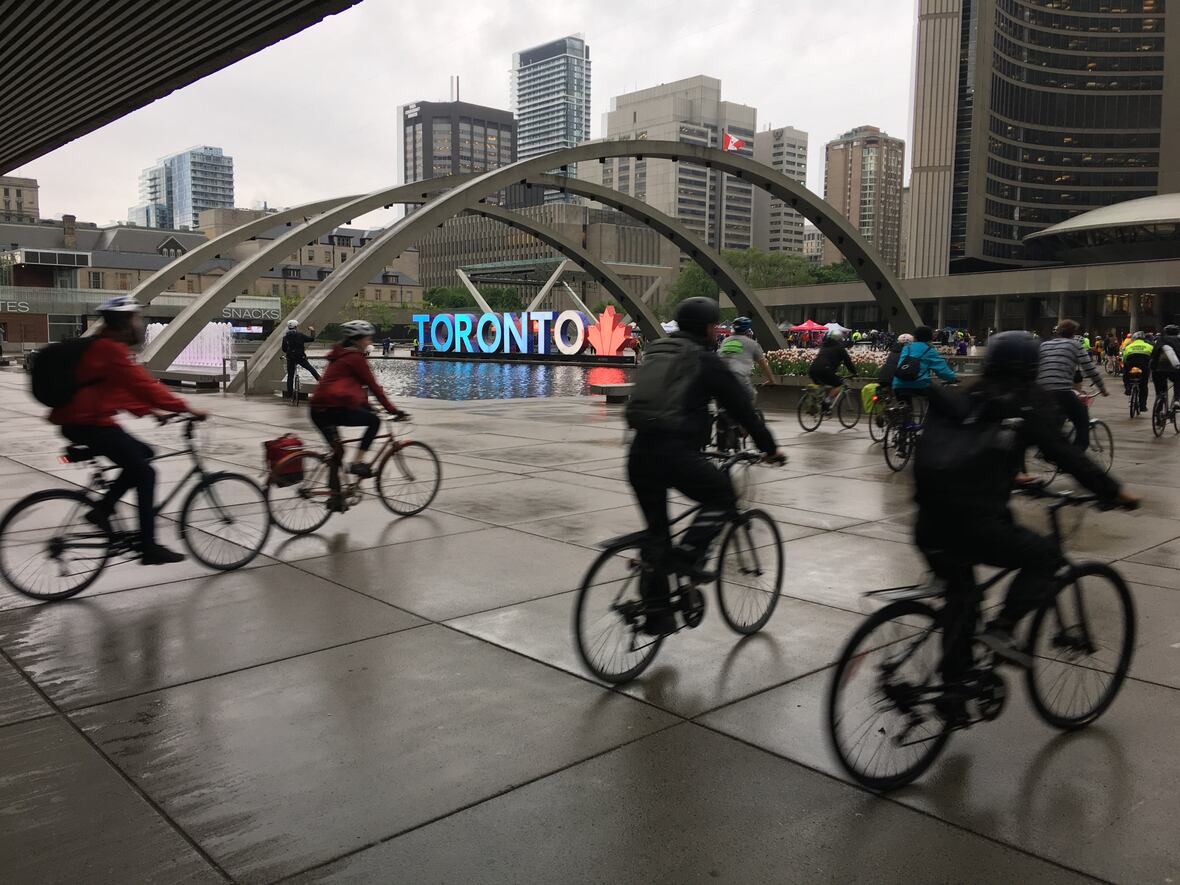
In Chicago, Toronto, Montreal and New York, bikes are given dedicated lanes on major roads – often protected by concrete barriers – which extend directly through their most dense and built-up areas. Where available space is scarce already, these cities are handing it over to cyclists and pedestrians. Why?
Once cyclists have a safe and direct route from one part of a city to another, the result is an immediate increase in the number of people cycling instead of driving. Rather than waiting for large numbers of people to start cycling before building the necessary infrastructure, the opposite appears to work far more effectively. To paraphrase Field of Dreams, “if you build it, they will ride.”
However, there is much debate over how to integrate safe and direct cycling routes into a city which until now has been designed with automobiles primarily in mind.
Many voices in the city, notably VIVA Port Credit and Smart Commute, advocate for marked and/or dedicated cycling routes on nearly every major road, arguing that people will cycle on roads at any rate, and cyclist safety must be given priority. Several cyclists have been killed or injured by cars in Mississauga in the past few years, so this is a valid point.
City planners counter that major roadways are the last place cyclists should be under any circumstances. Until recently, the overwhelming bulk of Mississauga’s cycling trails have been built off-road, usually in parkland and along waterways. This may have been done originally to protect cyclists from traffic hazards, but the result is a fragmented and unconnected system of pathways. Cyclists can be seen with their bikes on their cars, driving to a park instead of riding to it, simply because there is no way to get safely from one trail system to another.
If the Master Plan aims to prioritize safety and connectivity, it will have to find a way to accommodate cyclists on the city’s streets, or some other way for bikes to get around.
One possible alternative is to use old rail and hydro transmission corridors for direct cycling routes, as the city of Mississauga is hesitantly doing by building two pathways through the hydro transmission corridors parallel to The Queensway and Speakman Drive. This is actually the same corridor, but is being planned as two projects because no effort is being made to bridge the Credit River. Thus, although these routes will safely remove cyclists from traffic, it is questionable whether they will provide the level of direct connectivity that is required to convince people to trade their car for a bike.
If bike routes are isolated and tucked away from major areas, and do not provide convenient access to a variety of destinations, they will simply not succeed in attracting large numbers of cyclists. The evidence from other cities speaks for itself. A bold cycling vision can pay off by drawing people out of their cars, which in turn creates a more human and livable city.
Andrew Hamilton-Smith has lived in Mississauga for 25 years and is a member of the Mississauga Cycling Advisory Committee. The opinions expressed in this article are his own.


Mississauga bike maps
I believe “MINDSETS” about cycling must evolve by the public, government and engineers.
Roads and Pedestrian Ways, including multi-use trails, must be safe for all users.
1. A Bicycle doing 20km/h or more should not be allowed on multi-use trails but they do need a separate lane safely away from motorized cars, trucks and buses. Their space would be better beside a multi-use trail.
2. Signage and education for using multi-use trails requires:
a) All move forward on the right and pass on the left. Signage: Walk/Roll on the Right
b) Speed limit less than 20 km/hr.
3. Bicycle lanes must be designated by more than a line of paint and the odd sign. I believe cyclist need to quit competing with the roads department and start competing for space designated for road splash, boulevards, sidewalks, signage etc.except in the downtown cores, this area is seldom used. Access for young and old cyclists to get to schools, rec centers, churches, shopping, commercial and business areas etc must be made available for all types of rollers. I would go so far as to say that all sidewalks could be designated as multi-use ways to encourage children and seniors to ride more and feel safe and secure. HOW MANY CYCLISTS HAVE BEEN KILLED OR MAIMED BY PEDESTRIANS VS THE NUMBER OF CYCLIST WHO HAVE BEEN SERIOUSLY INJURED OR KILLED BY CARS?
Hope some of this has made sense to you.
Yours truly,
Donna
Hi Donna, thanks for your comments. I’m a little late in response, but your points make a good discussion. Note that these comments are my own personal opinion and not necessarily those of the MCAC:
(1) I agree and there is more and more discussion being generated regarding the widening of multi-use trails to make a “bikes only” section. It’s a great idea and is used by all the cycling-friendly cities around the world.
(2a) For paths that would not have the safer option of separate bike path demarcations, why not walk on your left and roll on the right? It works on the road a lot better than bikes surprising walkers/joggers from behind. Walkers have much better vision to move aside if need be.
(2b) Again, if the path had no separate bike section, perhaps have a guideline of using a safe/reasonable speed based on the amount of traffic and conditions. No one needs fixed speed limits on a bicycle, do they? If there did require a speed limit, I would pick 30 – 35 km/h. Cyclists who can pedal that fast can safely handle their bikes at that speed. Remember that bicycles are a lot more than coasting in the park. These trails are also used by people with schedules and business destinations.
(3) YES! The Cycling Master Plan – scheduled for public review in Spring 2010 – is rating the most needed cycling commuter areas that you listed.
I agree that the city/region needs to rethink the use of sidewalk space and consider adding in some “cycling highways” along the sidewalk space. I would guess none to few cyclists have been maimed by pedestrians, although both the pedestrian and cyclist are equally prone to injury if they collide (save for the likelyhood that the cyclist has a helmet and the pedestrian doesn’t).
Designating sidewalk spce is a much better idea than painting off small lanes for cyclists that make driving lanes for cars even more narrow. I am tired of sharing lane space with careless cyclists. Vehicle drivers pay a lot of money for the right to use the roads – drivers & vehicle licences, tire tax, gas tax etc. – that cyclists do not pay. Plus, regardless of how careless some cyclists are, drivers are always held accountable for accidents with cyclists. It’s time we get some fairness in the issue for drivers.