

Categories

Polls

How often do you ride a bicycle per month?

View Results

Loading ... Loading ...

About the Mississauga Cycling Advisory Committee

Mission Statement

The mission of the committee is to increase the quantity, quality and safety of cycling in Mississauga.

Mississauga Cycling Advisory Committee

The Mississauga Cycling Advisory Committee (MCAC), is a committee of Council which was formed in the fall of 1994. The committee is comprised of citizen volunteer representatives from the eleven wards plus two Ward Councillors and City staff from the Community Services, Transportation & Works, and the Planning and Building Departments. The Committee Chair is Jeff Wachman and the Vice Chair is Craig Laferriere.

The Committee meets to advise on various issues related to the cycling network in Mississauga. The committee reviews the proposed work scheduled for the upcoming year and advises on the potential new routes, which would make the whole trail network more enjoyable to all types of users. The Committee organizes various events such as the community cycling events.

The Committee has two sub-committees, The Communications Sub-committee and the Technical and Network Sub-committee, whose members are part of the overall committee. The Committee believes that Mississauga will benefit in many ways from a more extensive cycling system in that it will help promote:

  • Greater sense of community and personal contact
  • Less dependence on cars for all residents
  • Increased tourism and economic benefits by drawing cyclists to cycling destinations
  • More transportation options
  • Improved air quality
  • Increased opportunity for exercise and greater cardiovascular fitness
  • Greater safety for all
  • An easy way for family and friends to spend recreational time outdoors

The committee meets the second Tuesday monthly between September and June. If you are interested in serving on the cyling committee, please visit the Volunteering Web page. If you are interested in attending a meeting, please visit the Agendas & Minutes Web page, for the current agenda and approved Committee minutes.  

Why we advocate for better cycling conditions  

Reducing Health Care Costs

There is mounting evidence that physical inactivity is an ever-increasing public health burden. Health surveys indicate that over sixty percent of Canadians lead a sedentary lifestyle. Physical inactivity is a major risk factor for heart disease, stroke, high blood pressure, obesity, diabetes and osteoporosis, and is associated with higher incidences of colon and breast cancers. The economic implications of a sedentary lifestyle are immense. Recent data suggests the direct health care costs of inactivity in Canada are in excess of two billion dollars annually .

To realize the health benefit from a physically active lifestyle, one must only perform 30 minutes of moderate-intensity activity four days per week. In general, low-impact forms of exercise such as walking and cycling are favoured owing to ease of access, low cost and reduced rates of musculoskeletal injury. When used as a mode of transportation such as commuting to work, the potential health benefits of reduced vehicle emissions are another important public health consideration.

Almost one in four Canadian children aged seven to 12 is obese, according to the Heart and Stroke Foundation of Canada. Obesity has been called an “epidemic” in Canada, and it is a known risk factor for heart disease and stroke. Inner city children are particularly at risk, because their parents have a heightened concern for their children’s safety. This means they are more likely to stay in doors and watch television or play video games.

For Ontario, with approximately one third of Canada’s population, this means that the direct health care costs of physical inactivity are approximately $670 million annually. A proactive cycling policy that encouraged more Ontario residents to hop on their bicycles could therefore have a direct impact on reducing health care costs.

Encouraging Tourism and Economic Development

Many studies have shown that bicycle trails are an excellent way to stimulate economic development. For example, a study on Maryland’s Northern Central Rail-Trail found that while the trail’s cost to the public in 1993 was $US 191,893, it generated State tax revenue of $303,750 the same year. This revenue was a direct result of a growing economy’s sales, property, and income taxes. The study found that

if two identical properties are for sale and one is near the trail and the other is not, the trail is used as a selling point and helps many nearby owners sell their property faster.

The Northern Central Rail-Trail attracts 457,000 visitors every year and has had an enormous economic impact on nearby businesses, leading to the creation and support of 262 jobs. These positions range from trail construction and maintenance work, to jobs in local restaurants and hotels serving trail users, to added positions in regional sporting goods companies and supermarket chains due to increased business.

The 376 kilometre (235-mile) Katy Trail traverses nine counties and adjoins 35 towns in Missouri, ranging in population from 60 to 60,000. Within weeks of the trail dedication, new and old businesses were vying for tourist dollars. Restaurants, bed-and-breakfasts, bicycle rental shops, antique dealers and campgrounds all opened to meet the needs of hundreds of thousands of visitors. A 1993 user survey on the trail’s western half showed that it generated an estimated $3 million in local revenue.

“Walking and biking paths” ranked third among 39 features identified by homebuyers as crucial factors in their home-purchasing decisions, according to a 1994 study by American Lives, a research firm serving the real estate industry.

Environmental (air quality) benefits

The National Round Table on Environment and Economy recommends, in several separate recommendations, that cycling be given a higher priority in federal, provincial and municipal planning because of its environmental benefits.


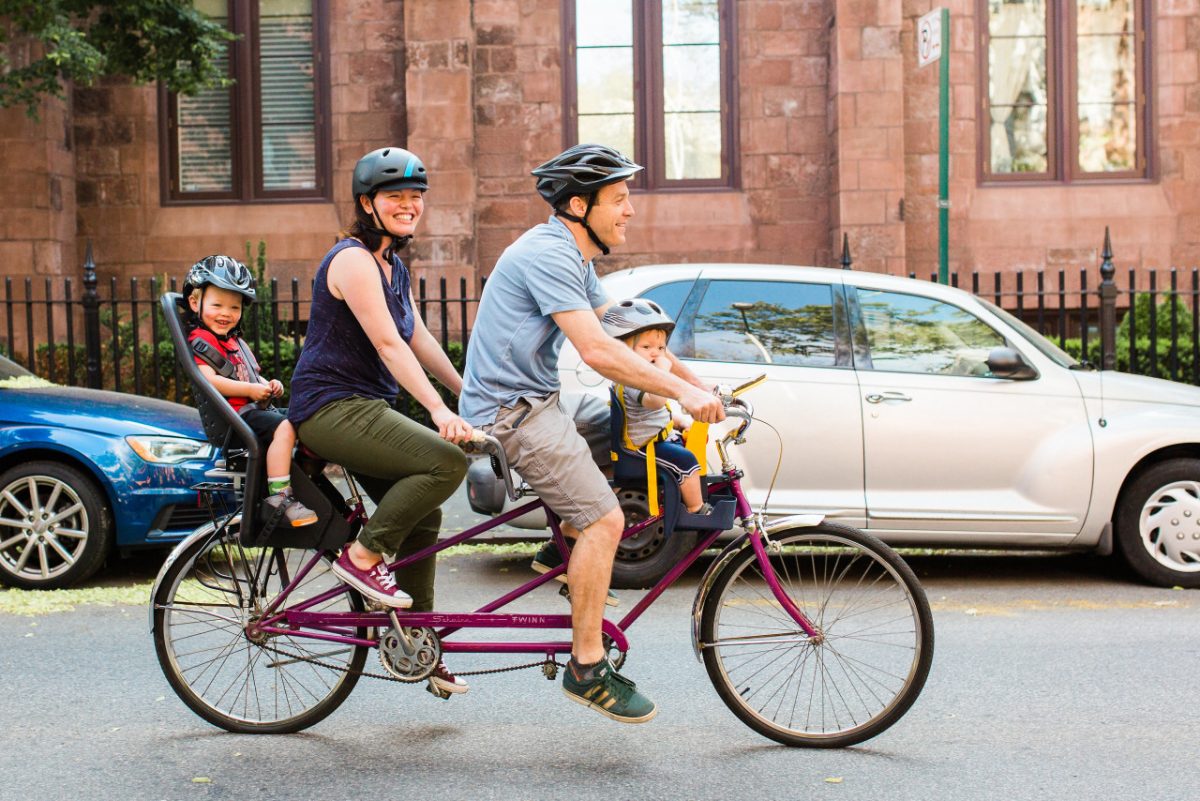
Photo from: http://www.treehugger.com/

Recent studies have shown that close to eight percent of all non-traumatic mortality in Canadian cities is attributable to air pollution caused by the burning of fossil fuels .

A bicycle policy which resulted in more people cycling or using a combination of cycling and public transit would help alleviate these problems.